 Wulong Tours
Home › Guides › What Is the Wulong Karst? Bridges, Gorges and Caves of Chongqing
What Is the Wulong Karst? Bridges, Gorges and Caves of Chongqing
The Wulong Karst is a UNESCO World Heritage area about 129 km from central Chongqing, built around giant collapse depressions called tiankengs, three natural bridges and Furong Cave. This guide covers what the scenic areas are, why UNESCO listed them, how to get there, how long a visit takes, what the gate tickets cost and which Wulong tours cover each area. The short version: the fastest train reaches Wulong South station in 34 minutes, and one long day covers the bridges plus one or two more areas.
Quick answer What the Wulong Karst is and how to see it
The Wulong Karst is a UNESCO World Natural Heritage area in Chongqing, about 129 km from the city centre. The Chongqing government describes its tourism area as three parts: Three Natural Bridges, Fairy Mountain and Furong Cave, and the heritage site also takes in Longshuixia Fissure. The fastest train from Chongqing East reaches Wulong South station in 34 minutes, while the day tours from Chongqing drive about 3 hours each way.
Key takeaways
- The cheapest day trip from Chongqing is $90, park tickets extra: see all Wulong tours side by side.
- Three Natural Bridges with Longshuixia Gorge or Fairy Mountain pairs the bridges with a second area in 13 hours for $122.
- Add alpine grassland with a Wulong Karst and Fairy Mountain small-group day trip.
- Prefer your own group and pace with the Wulong National Park private tour.
Is the Wulong Karst one single park with one gate?
No, it is a cluster of three separate core zones, each with its own entrance, ticket and buffer zone.
The heritage site and the tourism area are drawn differently, and neither is one park with one gate. Each area sells its own ticket.
The three listed systems
UNESCO lists the Wulong Karst as a cluster of three core zones, each with its own buffer zone. The Wulong District government names them as the Furong Cave system, the Three Natural Bridges karst system and the Houping erosional tiankeng karst system. The district's protection scope covers the Three Natural Bridges area including Longshuixia Fissure, the Furong Cave area including the Furong River basin, and the Houping erosional tiankeng area.
For a practical visit, the Chongqing government describes the tourism area as three parts: Three Natural Bridges, Fairy Mountain and Furong Cave. In Chinese, locals say Wulong Tiankeng when they mean the Three Natural Bridges, which is a different place from the Fengjie Tiankeng Difeng scenic area. The table shows what each area holds and where it sits.
| Scenic area | What you see | Where it sits |
|---|---|---|
| Three Natural Bridges | Tianlong, Qinglong and Heilong bridges, plus Longshuixia Fissure | East of Fairy Mountain town, 20 km from Wulong urban area |
| Fairy Mountain | Forest and grassland, peak 2,033 m | North bank of the Wujiang River |
| Furong Cave | Show cave, 1,860 m visitor path | Jiangkou town, 21 km from Wulong urban area |
| Houping Tiankeng | Erosional tiankeng system named in the listing | On the private day with Furong Cave and Houping Tiankeng |
Sources: UNESCO World Heritage Centre, Chongqing Municipal Government, Wulong District Government, Chongqing Local Chronicles Office.
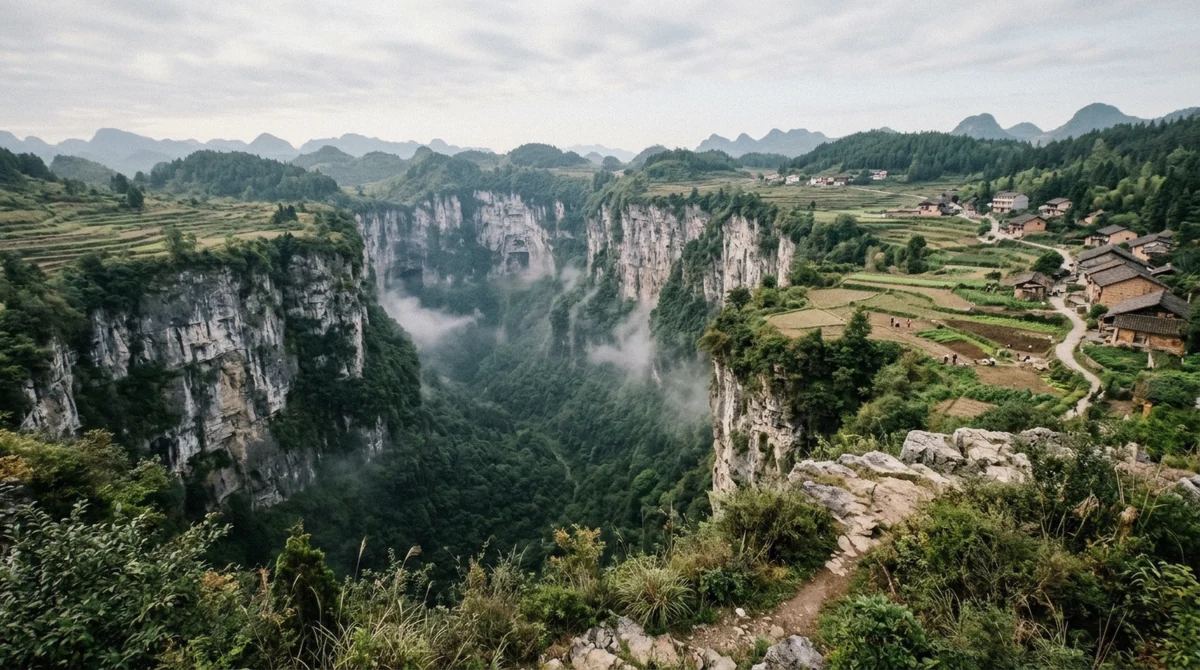
A tiankeng, the giant collapse depression the Wulong Karst is known for.
Is the Wulong Karst just a big cave?
No, Furong Cave is only one part, and the headline sights are giant collapse depressions called tiankengs and exceptionally high natural bridges between them.
The karst is best understood as a landscape shaped by water dissolving limestone over millions of years, not a single cave.
Why UNESCO listed it
Wulong was inscribed on 27 June 2007 as part of Phase I of the South China Karst, together with Shilin and Libo, and became China's sixth World Natural Heritage Site. South China Karst is a serial property of seven karst clusters in four provinces, and Wulong is one of them.
UNESCO's criterion (vii) text singles out Wulong for giant collapse depressions called Tiankeng and exceptionally high natural bridges between them, with long stretches of deep unroofed caves. UNESCO says the component consists of high inland karst plateaux that have experienced considerable uplift, and that the dolines and bridges provide evidence for the history of the Yangtze and its tributaries. The three Wulong core zones total 6,000 hectares, with buffer zones of 32,000 hectares.
| Listed element | Key figure |
|---|---|
| Inscription year | 27 June 2007, Phase I of South China Karst |
| Serial property | Seven karst clusters in four provinces |
| Wulong core zones | 6,000 ha, buffer zones 32,000 ha |
| Furong Cave | Main passage 2,700 m, visitor path 1,860 m |
The bridges themselves
The Three Natural Bridges, named Tianlong, Qinglong and Heilong, stand within a 1.2 km stretch of the middle Yangshui River canyon and form the largest group of natural bridges in Asia. Tianlong Bridge is 235 m high and Heilong Bridge 223 m high, and Qinglong is the tallest of the three. The Chongqing local chronicles office gives the scenic area a total area of 64 square km with a visitor walking route of 2,300 m, while the provincial scenic area approval sets a total area of 35.69 square km with a 7.22 square km core.
Inside the boundary, quarrying, mining, land clearing and grave building are banned.
| Bridge | Name in English | Height |
|---|---|---|
| Tianlong | Heaven Dragon | 235 m |
| Qinglong | Green Dragon | Tallest of the three |
| Heilong | Black Dragon | 223 m |
Sources: UNESCO World Heritage Centre, Chongqing Municipal Government, Chongqing Local Chronicles Office, Chongqing Government PDF.
Was Transformers filmed at Wulong, and is it the same place as Fengjie's tiankeng?
Transformers: Age of Extinction was filmed at Three Natural Bridges in 2014, and Wulong is a different site from the Fengjie Tiankeng Difeng scenic area.
Film fame draws many visitors, and place-name confusion sends some of them to the wrong district entirely.
Movies shot here
The Chongqing government says Transformers: Age of Extinction was filmed at Three Natural Bridges in 2014 and made Wulong known internationally. Wulong government guides also name Three Natural Bridges as the only exterior location of Curse of the Golden Flower and a location of Once Upon a Time in Three Lifetimes. The Tianfu Post courtyard, 600 m from the scenic area entrance, was rebuilt in 2006 for Curse of the Golden Flower.
The Wulong government also notes that the local name Wulong Tiankeng means the Three Natural Bridges. That is a different place from the Fengjie Tiankeng Difeng scenic area, so check the district before you book a ticket or a driver.
| Film | Location used |
|---|---|
| Curse of the Golden Flower | Three Natural Bridges, the only exterior location |
| Transformers: Age of Extinction | Three Natural Bridges, filmed in 2014 |
| Once Upon a Time in Three Lifetimes | Three Natural Bridges |
Sources: Chongqing Municipal Government, Wulong Government, Wulong District Government, Chongqing Local Chronicles Office.
How do I get to Wulong Karst from Chongqing?
Take the high-speed train from Chongqing East to Wulong South, about 34 minutes at the fastest, or drive about 129 km from central Chongqing.
The rail link puts Wulong about an hour from the city by train, against three to four hours by car in traffic.
By train
The Yuxia high-speed line from Chongqing East to Qianjiang stops at Wulong South station. At its opening, 12306 listed five daily trains from Chongqing East to Wulong South, the fastest taking 34 minutes. The line is designed for 350 km/h and runs up to 54 trains a day along its length.
An official report puts the trip from Chongqing main city to the foot of Fairy Mountain at about one hour by high-speed rail, against three to four hours by car in traffic. Fares are set on 12306, so check the current price there when you book.
By car or coach
The Banan to Wulong section of the Yuxiang second expressway runs 127 km, with a toll of about $15.29 (¥102) for a small car, per the Chongqing government. A guided tour removes both legs from your planning. The Wulong Karst Small-Group Day Tour from Chongqing drives about 3 hours each way within a 12-hour day, and the Wulong Karst English-Language Small-Group Tour has an English-speaking guide on board over a 10-hour day.
Sources: Chongqing Municipal Government, Chongqing Municipal Government, Chongqing Municipal Government.
Tours That Fit
Day trips from Chongqing that cover the Wulong Karst highlights.
 from $100
Editor's pick
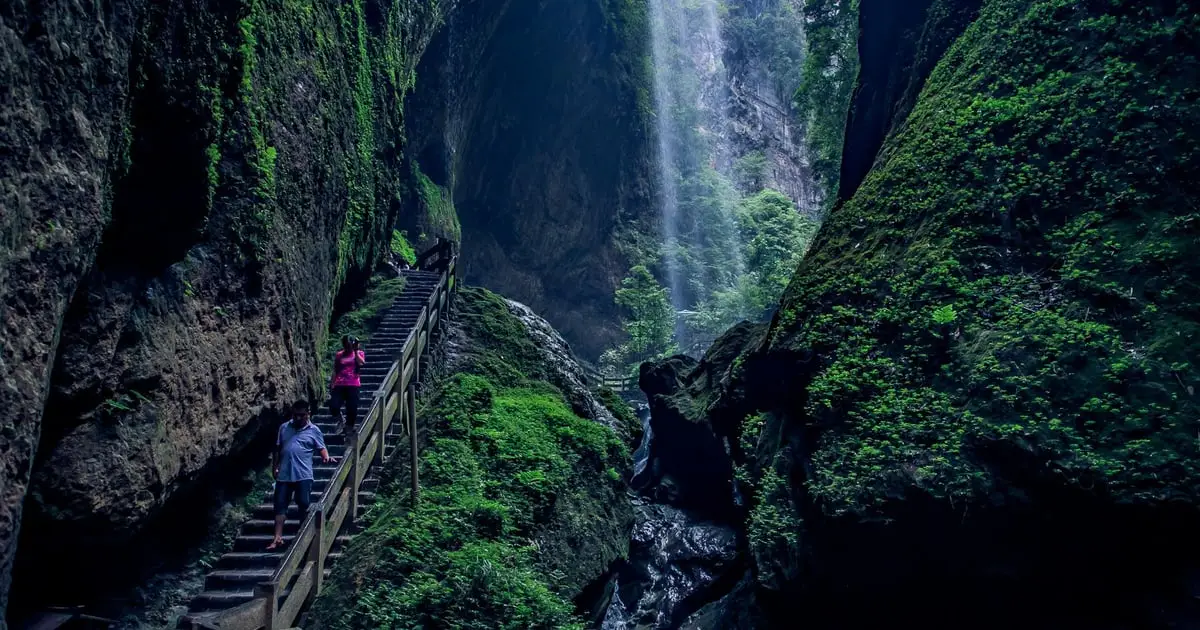
Wulong Karst Small-Group Day Tour from Chongqing
A 12-hour shared day from central Chongqing with an English-speaking guide and the entry tickets for the sites you choose in the price.
Check Availability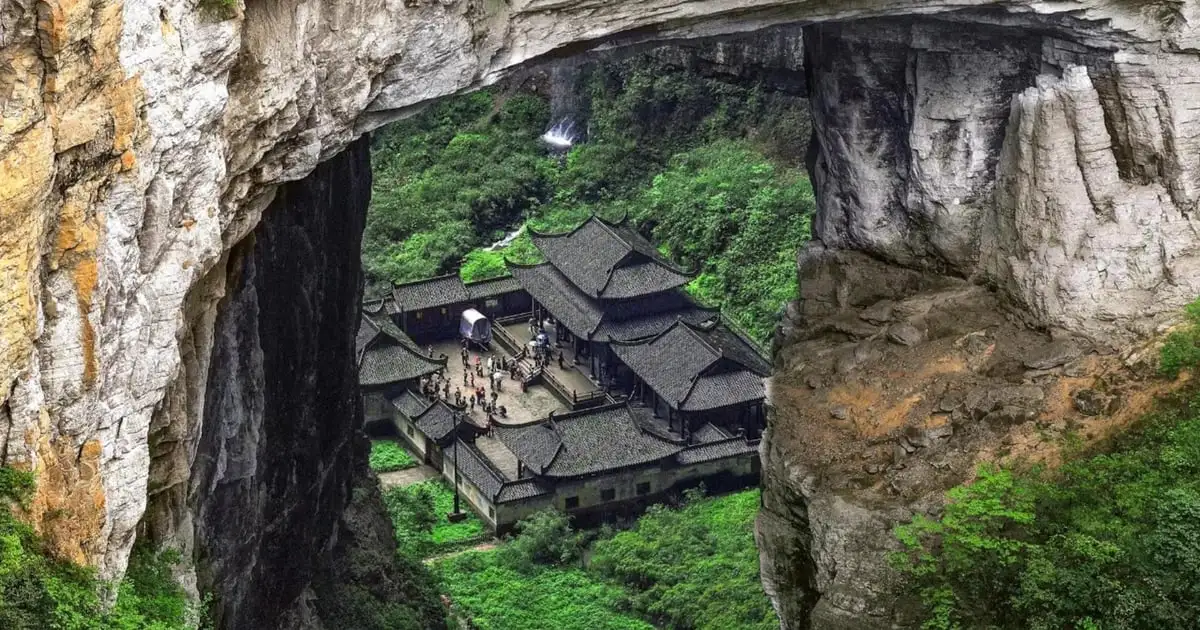 from $122
Most reviewed
Three Natural Bridges with Longshuixia Gorge or Fairy Mountain
The most-reviewed Wulong day: Three Natural Bridges plus Longshuixia Gorge or Fairy Mountain, tickets, shuttle and lift in the price, guide optional.
Check Availability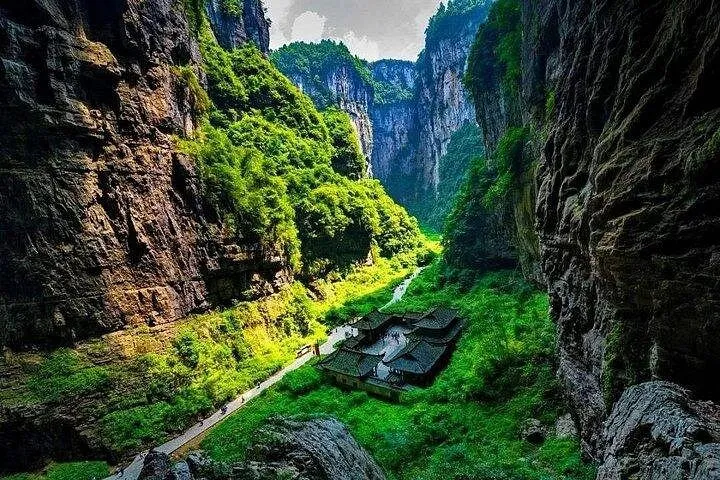 from $299
Top rated private
Wulong National Park Private Tour from Chongqing
A private car and driver-guide from your Chongqing hotel, priced per group with lunch, the park tickets paid on top.
Check Availability from $143
Wulong Karst English-Language Small-Group Tour
A small group with an English guide on board who waits outside the parks, tickets and lifts paid on site.
Check AvailabilityHow long do I need to explore Wulong Karst, and can you do it in one day?
One long day is enough for the two headline sights, the bridges and one more area, but a relaxed visit to all three zones deserves two days.
Timings depend on how many of the three areas you want and how much walking you accept.
What fits in a day
The visitor walking route through Three Natural Bridges is 2,300 m, and the tours give it 1.5 to 2 hours. Every day tour from Chongqing also drives about 3 hours each way, which is why the tours run 9 to 13 hours even with one or two areas.
The table lists the day tours by length. Prices are per person except the private tour, which is priced per group. On the private tour the Three Natural Bridges ticket and the park battery car are paid on top. On the English-language group the entry tickets, shuttle and lifts cost $38.97 (¥260) per person from March to November or $31.48 (¥210) from December to February, paid to the guide on site.
| Tour | Duration | Price | Rating |
|---|---|---|---|
| Wulong Karst Small-Group Day Tour from Chongqing | 12 hours | $100 per person | 4.9 (29 reviews) |
| Three Natural Bridges and Fairy Mountain Day Tour | 9 to 12 hours | $110 per person | No reviews yet |
| Three Natural Bridges with Longshuixia Gorge or Fairy Mountain | 13 hours | $122 per person | 4.7 (115 reviews) |
| Wulong Karst English-Language Small-Group Tour | 10 hours | $143 per person | 5 (2 reviews) |
| Wulong Karst and Fairy Mountain Small-Group Day Trip | 11.5 hours | $216 per person | No reviews yet |
| Wulong National Park Private Tour from Chongqing | 10 to 11 hours | $299 per group | 5 (115 reviews) |
Adding Fairy Mountain or Furong Cave
Fairy Mountain rises to 2,033 m at Mocaowan, the highest point in Wulong District, and its average summer temperature is 22 C. Furong Cave sits in Jiangkou town, 21 km from Wulong urban area, and its visitor path is 1,860 m. The one day tour that fits the bridges, Longshuixia Gorge and Furong Cave gives each 1 to 1.5 hours. For a slower pace, the 2-Day Wulong Tour: Bridges, Furong Cave, Boat and Show adds Fairy Mountain, a Furong River boat and the Impression Wulong show.
| If you want | Plan for |
|---|---|
| Bridges only | One long day |
| Bridges plus Fairy Mountain | One long day, 9 to 13 hours on a tour |
| Bridges, Fairy Mountain and Furong Cave | Two days, as on the 2-day tour |
| Houping Tiankeng | The 10-hour private day with Furong Cave and Houping Tiankeng |
Sources: Chongqing Local Chronicles Office, Chongqing Municipal Government.
What is a Wulong Karst ticket and what does it cost?
Each scenic area sells its own gate ticket, with official peak-season prices of $10.49 (¥70) for Three Natural Bridges, $7.49 (¥50) for Fairy Mountain and $11.99 (¥80) for Furong Cave.
There is no single Wulong Karst ticket covering everything, so check which areas your plan includes.
Official prices
The district's official list of Wulong A-level scenic areas gives peak-season gate tickets of $10.49 (¥70) for Three Natural Bridges, $7.49 (¥50) for Fairy Mountain and $11.99 (¥80) for Furong Cave, with lower off-season prices for the bridges and the cave. The Chongqing Culture and Tourism Commission's 5A list shows the same prices and names the operator as Chongqing Wulong Karst Tourism Industry (Group) Co. Ltd. A first-gate ticket does not cover the transfer bus, battery car, cable car, elevator or small train, which are separate charges.
Reserve through the WeChat mini-program Wulong Karst Tourism Area, the WeChat public account Wulong Jingqu, or online agencies such as Qunar, Meituan and Ctrip, as listed by the district. The official contact phone for the tourism area is 4000235666. The Three Natural Bridges or Longshuixia Gorge Ticket at $15 includes the shuttle bus and elevator, and the Wulong Karst ticket guide explains each option.
| Scenic area | Peak season | Off season |
|---|---|---|
| Three Natural Bridges | $10.49 (¥70) | $6.00 (¥40) |
| Fairy Mountain | $7.49 (¥50) | $7.49 (¥50) |
| Furong Cave | $11.99 (¥80) | $9.74 (¥65) |
Sources: Wulong District Government, Chongqing Culture and Tourism Commission, Chongqing Municipal Government.
Is Wulong Karst worth visiting, and where is the map of the areas?
Yes, it is a UNESCO World Heritage site and a national 5A scenic area, and three of its areas sit 15 to 21 km from Wulong urban area.
Its listing explains why people go, and the distances explain how a day fits together.
Why it earns its reputation
The Chongqing government lists the Wulong Karst tourism area among Chongqing's national 5A scenic areas, approved on 6 July 2011, and UNESCO inscribed South China Karst under natural criteria (vii) and (viii). The area sits in southeastern Chongqing on the lower Wujiang River, with a humid subtropical monsoon climate and an average annual temperature of 17.4 C. The landscape is described as seven parts mountain, one part water and two parts farmland. The table gives each area's official distance from Wulong urban area.
| Map point | Distance from Wulong urban area |
|---|---|
| Longshuixia Fissure | 15 km |
| Three Natural Bridges | 20 km |
| Furong Cave, Jiangkou town | 21 km |
Reading the map
Three Natural Bridges lies east of Fairy Mountain town, 20 km from Wulong urban area. Longshuixia Fissure lies west of Baiguo town, 15 km from the urban area. Furong Cave sits on the right bank of the Furong River in Jiangkou town, 21 km out.
Fairy Mountain is on the north bank of the Wujiang River and peaks at 2,033 m. The Impression Wulong theatre is in Taoyuan Grand Canyon, about 9 km from Fairy Mountain town. Houping erosional tiankeng, the third listed heritage system, is visited on the 10-hour private day with Furong Cave and Houping Tiankeng.
Sources: Chongqing Municipal Government, Chongqing Municipal Government, UNESCO World Heritage Centre, Chongqing Local Chronicles Office, Wulong District Government.
How do you combine Wulong with Zhangjiajie?
No tour here continues to Zhangjiajie, so plan Wulong as a day from Chongqing and book the onward leg separately on 12306.
Travellers who like rock landscapes often ask about linking two karst regions in one trip. Chongqing is the hub for that plan.
Planning the combination
Every Wulong day tour compared here starts and ends in Chongqing, and the 4-Day Wulong Karst and Chongqing Tour begins and ends at Chongqing Jiangbei International Airport. So the simple shape is Chongqing first, a Wulong day trip, then your onward journey from the city. The Yuxia high-speed line runs from Chongqing East through Wulong South to Qianjiang, is designed for 350 km/h and runs up to 54 trains a day along its length.
Check the onward train on 12306 before you fix the order of your trip. Wulong is one of seven South China Karst clusters, alongside Shilin, Libo, Guilin, Shibing, Jinfoshan and Huanjiang, if karst is the theme of the route.
Sources: Chongqing Municipal Government, UNESCO World Heritage Centre.
Wulong Karst FAQ
Is Wulong Karst worth visiting?
Yes. It is a UNESCO World Natural Heritage Site and a national 5A scenic area, and Tianlong Bridge alone stands 235 m high. Compare the ways to see it on the Wulong tours page.
How long do I need to explore Wulong Karst?
One long day covers Three Natural Bridges plus one or two more areas, since the bridge walking route is 2,300 m and tours run 9 to 13 hours. See the day lengths by tour. All three areas plus the show deserve two days.
How do I get to Wulong Karst from Chongqing?
The fastest is the high-speed train from Chongqing East to Wulong South: five daily trains at launch, the fastest in 34 minutes. Driving is about 129 km from central Chongqing. The Chongqing to Wulong guide covers each option.
Can you do Wulong Karst in one day?
Yes. The Wulong Karst Small-Group Day Tour from Chongqing fits Three Natural Bridges, Longshuixia Gorge and Furong Cave into 12 hours, with 1 to 1.5 hours at each. Add the show or a boat and you need an overnight stay.
What is Fairy Mountain?
It is a forest and grassland scenic area on the north bank of the Wujiang River, peaking at 2,033 m, with an average summer temperature of 22 C. You can pair it with the bridges on the Wulong Karst and Fairy Mountain Small-Group Day Trip.
Was Transformers filmed in Wulong Karst?
Yes. Transformers: Age of Extinction was filmed at Three Natural Bridges in 2014, and Curse of the Golden Flower used the bridges as its only exterior location.
Where is the Wulong Karst map?
Longshuixia Fissure is 15 km from Wulong urban area, Three Natural Bridges 20 km and Furong Cave 21 km in Jiangkou town. Fairy Mountain is on the north bank of the Wujiang River. See the distance table.
How do you combine Wulong with Zhangjiajie?
Use Chongqing as your hub: visit Wulong as a day trip, then book the onward leg on 12306. No tour compared here links the two parks, as the planning section explains.
More Guides
- Three Natural Bridges in Wulong: How to Visit the Tiankeng
Three Natural Bridges 2027: the 2,300 m canyon walk, hours, tickets and how to get there from Chongqing. Plan your Wulong day.
- How to Get from Chongqing to Wulong by Train, Car or Tour
Wulong is 129 km from Chongqing and the fastest train takes 34 minutes. Compare train, car and tour options in 2027 and plan your karst day trip.
- Wulong Karst Ticket Prices and Which Ticket to Buy
Wulong Karst ticket prices for 2027, what each ticket covers and which one suits a day trip. Compare options and book with free cancellation.